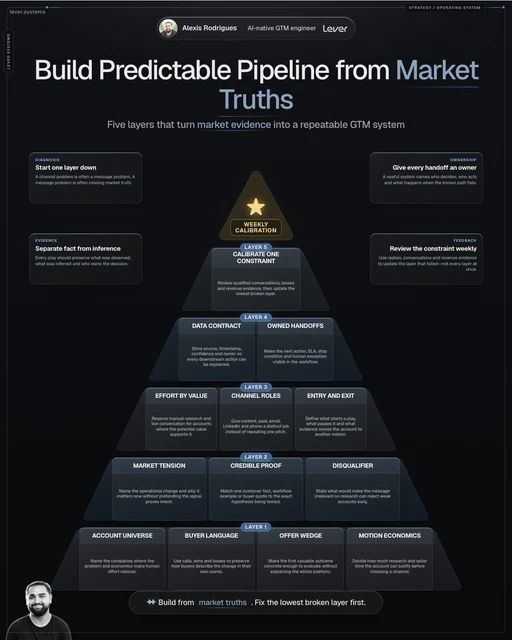
9 GTM operating systems

System library.

Reusable systems for turning market evidence into clear decisions, owned actions and workflows your team can run.

Browse GTM operating systems

9 systems

2026 Signal Map

Direct, resolved and public: three provenance layers for buyer evidence

Clay
Direct evidenceCaptured in systems you controlCRM dataCall transcriptsProduct usageMarketing sequenceMeeting formsGated contentLinkedIn signalsAd engagement
Resolved evidenceA provider identifies or enrichesWebsite visitorAffinity signalsChampion tracking

Public evidenceObserved, licensed or scrapedWeb dataWeb data agentsFunding announcementsJob openingsSearch trendsSocial engagementFirmographic dataTechnographic dataLookalike searchNewsAds activityReview sitesCustom scraping

Store source, timestamp and confidence. Score only what the team can explain.

Alexis Rodrigues
SignalsFind the moment

The 2026 Signal Map

A provenance map for separating direct, resolved and public evidence before any signal enters a score.

Explore system


Turn market signal into always-on pipeline

Capture evidence. Score fit. Keep a human owner. Route the next action.

1 Capture SignalClay

First-party

Second-party

Third-party

Capture, orchestrate, enrich.

Existing paid tools first. New tools must earn their ROI.

2 Score

ICP criteria validated by the team

Score + tier accounts.

Tier 1

Deep research + multi-channel

Tier 2

Targeted personalization + multi-channel

Tier 3

Templated outreach + single channel

3 HITL (human in the loop)Slack

One owner per account

No owner? Round-robin to an AE

Approve

Reject

4 Route

After approval

Sync

Notify

Send

Alexis Rodrigues
SignalsFind the moment

Turn Market Signal into Always-On Pipeline

The end-to-end operating layer that captures evidence, scores fit, keeps a human in the loop and routes the next action.

Explore system

Series A + GTM Funnel

The tech stack I run end to end: from signal to signed

Lead GenerationBuild a named market from evidence
Intent
Data
Web data
Search / AI
Lead CaptureResolve demand into people + accounts
Visitor ID
Forms
Content
Lead ManagementScore evidence + assign ownership
Enrich / Score
Analytics
Routing
Automation
Lead ConversationCreate context + return the learning
CRM
Calls
Proposals
Alexis Rodrigues
StrategyRun the stack

Series A + GTM Funnel

A four-stage view of the GTM stack a Series A team needs to generate, qualify, convert and learn without a large ops team.

Explore system

When Content, Ads and Outbound Actually Compound

Channels compound when they share the same account, idea and feedback loop.

Content

  • Builds trust before the first ask.
  • Makes the market problem easier to recognize.
  • Creates proof outbound can reference.
  • Shows which ideas earn account attention.
  • Feeds buyer language back into the narrative.

Ads

  • Keeps a useful idea visible inside the ICP.
  • Adds account-level air cover around priority plays.
  • Tests which proof earns the next visit.
  • Bridges the gap between a post and a seller touch.
  • Maintains familiarity between conversations.

Outbound

  • Turns account context into a direct conversation.
  • Tests whether the market tension is real now.
  • Uses live evidence instead of synthetic personalization.
  • Captures objections content and ads cannot hear.
  • Writes replies and outcomes back to the system.
Content + Ads

Build memory

Content supplies the idea. Paid distribution keeps that idea visible across the accounts that matter.

Content + Outbound

Turn attention into context

Seller outreach references a real point of view and returns objections to the next content brief.

Ads + Outbound

Stay present between touches

Paid air cover maintains familiarity while outbound focuses on the accounts with a reason to engage now.

One Account Truth

The same market tension, account context and conversation history shape what every channel does next.

1

Define one ICP and market tension

Every channel starts from the same account universe and the same operational problem worth discussing.

2

Share account-level context

Exposure, engagement, research and seller notes resolve to one account history instead of separate dashboards.

3

Trigger outbound only with context

A seller acts when fit, timing and a defensible reason now agree—not because another sequence needs contacts.

4

Compare exposed and unexposed accounts

Measure whether coordinated exposure changes qualified conversations, not whether one channel claims the conversion.

5

Feed conversations into the next brief

Replies, objections, wins and losses update the narrative so the next cycle starts with better evidence.

One ICP. One narrative. One feedback loop.
Alexis Rodrigues
ContentCreate demand

Make Content, Outbound and Paid Compound

A coordinated loop for content, outbound and paid distribution to compound around one ICP instead of competing for attribution.

Explore system

Cold Email vs LinkedIn DMs vs Cold Calling

Choose coverage, context or live effort from account value and evidence.

FactorLinkedIn DMsCold calling
Reach model
Context.Selective conversations.Role, history and platform behavior matter.
Live effort.Real-time discovery.Rep time and contactability set the limit.
TAM
Selective.Best when account and role context change the message.
Focused.Reserve live effort for accounts worth the conversation.
Approach
Context before ask.Use role, relationship and point of view.
Adaptive discovery.Test urgency, ownership and objections live.
Data
Social graphMutuals
Direct dialsOrg chart
Tools
Sales NavWorkflowsCRM
DialerCRM
Scalability
Operator-limited.Context improves quality but reduces throughput.
Rep-time limited.More activity does not remove the need for live judgment.
Effort fit
Context play.Named accounts where role and relationship matter.
Urgency play.High-value accounts with a reason for live discovery.
Best use cases
Account context.Map roles, warm a relationship and add a point of view.
Live qualification.Resolve urgency, ownership and objections quickly.
Main challenge
Manual context is expensive.Generic automation destroys the advantage.
Time-heavy.Contactability varies.Poor prioritization wastes rep effort.
Relationship building
Context-rich.Useful for role mapping and ongoing familiarity.
Conversation-rich.High learning density when the timing is right.
Give every channel one job. Then coordinate the sequence.
OutboundFind the moment

Match Every Account to the Right Channel

A decision framework for matching email, LinkedIn and phone to account value, signal strength and required context.

Explore system

Your GTM AI Is Only as Good as Its Memory

17 tools. 3 memories. One shared context layer.

What changed outside the account

Perplexity

Category shifts + sourced research

Common Room

Community + social signals

LinkedIn

Role changes + public activity

G2

Category intent + review language

TheirStack

Hiring + technographic change

What the buyer did and where the relationship stands

Clay

Research tables + enrichment state

HubSpot

Lifecycle, ownership + activity

Attio

Flexible relationship context

Salesforce

Enterprise account history

Harmonic

Company + people graph

BuiltWith

Technographic change

RB2B

Known website activity

What the buyer actually said and decided

Gong

Calls, objections + deal context

Fathom

Meeting notes + commitments

Fireflies

Searchable conversation archive

Slack

Internal decisions + handoffs

Notion

Narrative, playbooks + learning

Agents don’t need more prompts. They need shared memory.
StrategyRun the stack

Build the Memory Layer Before You Add GTM Agents

A three-layer map of the market, account and conversation context GTM agents need before they can make useful decisions.

Explore system

How to run multichannel outbound like a system

One account. One narrative. Every channel adds context.

01

Evidence

Know the account

Account fitICP, size, stack and operating model
Buyer intentWebsite, community and social activity
Why nowRole change, hiring or category shift
RelationshipPrevious touches, objections and stage
02

Decision layer

Match effort to value

01
FitShould we pursue?
02
TimingWhy now?
03
EffortHow much human time?
Tier 1Research-ledManual + phone
Tier 2Coordinated3-channel play
Tier 3ProgrammaticEmail-first
Selected playTier 2 · coordinated · founder-led
03

Channel plays

Give every channel a job

LinkedInBuild familiarityMake the name recognizable before the ask.
EmailExplain relevanceTurn the signal into a clear business reason.
PhoneQualify liveCapture the objection while it is still useful.
PaidReinforce recallKeep the same narrative visible between touches.
04

One narrative, six coordinated touches

Each step adds context instead of repeating the same pitch.

D0SignalWhy now
D1ProfileFamiliarity
D2EmailRelevance + proof
D4Social touchNew context
D6CallLive feedback
D8RecallSame narrative
Operating guardrails
One account owns the narrativeEach touch adds new informationStop every sequence on replySync every outcome to the CRM
More channels don’t create relevance. Shared context does.
OutboundFind the moment

Make Every Outbound Touch Earn the Next

An account-level operating map that turns evidence into effort, coordinates channel roles and feeds every response back into the CRM.

Explore system
Alexis RodriguesAI-native GTM engineer
Content system

Always-On LinkedIn Competitive Intelligence

New competitor LinkedIn evidence

Content
Before
+
Now
change detectedNormalize and tag
ContentSalesProduct
Visual template for Always-On LinkedIn Competitive Intelligence
Persistent system outputs
01Living library
02Searchable taxonomy
03Editorial brief
04Update loop

Operating ruleSourced editorial brief

LinkedInApifyClaudeNotionSlack
ContentCreate demand

LinkedIn Competitive Intelligence

Turn the public LinkedIn output of the competitors that matter into a living, searchable source for editorial decisions.

Explore system
Build the useful version

Start with the constraint costing your team time or pipeline.

Bring the workflow, the stack and the edge cases. We will isolate the first system worth building inside the way your team already works.