Swan
Swan stopped needing a BDR desk for inbound
“I shipped inbound routing so hot leads hit AEs in minutes, then cleaned the data layer, sized markets for leadership, and left forecast and tooling work that still runs without me.”
Swan is a European banking-as-a-service platform. Partners embed accounts, cards, and payments under Swan’s license. GTM runs across Sales & International in Europe.
Visit Swan ↗Swan’s best new pipeline still came from Talk to an Expert. Before anyone booked a call, someone had to open the lead, decide if it was real, and ping the right AE. When that coverage slipped, leads sat for ~17 hours.
I shipped the routing system that replaced that desk, then kept going: CRM and TAP coverage AEs could use, a defensible account universe for leadership, a launch list for a new regulated vertical, a forecast agent, and tooling cuts that saved real spend.
Impact highlights
- Inbound: ~17h → under 10 min on hot leads; SLA under 2h hit ~99% after launch
- Sample run: 240 leads in, 38 routed (noise filtered before AEs)
- ~1,700 new TAP contacts across 335 companies
- An FI account universe rebuilt from a public register, the CRM and web research, with every exclusion documented by category
- Compliance-validated account lists for a new regulated vertical, plus the ramp doc behind them
- Forecast agent recovers ~8h/week of senior time; still runs without a RevOps hire
- ~37k wasted enrichment credits/month stopped
- Full CRM audit on ~40k records: 2–3 days → ~1h30 with Claude Code
The problem
Inbound triage sat on people. The CRM had duplication, missing firmographics, and TAP accounts without the right contacts. Forecasting was a weekly manual pile. Leadership had no defensible FI account universe for board reporting.
I needed systems that qualify and route leads, give AEs usable coverage, produce board-grade lists, and keep running after I left.
The solution
I built the inbound qualify-and-route flow first: score every lead, four buckets, Slack for hot ones, nurture or decline for the rest, docs so someone else can own it.
In parallel I cleaned and enriched CRM/TAP data, built account universes for Marketing and Sales, shipped a monthly forecast agent, and cut dead automation spend while speeding RevOps work with coding tools the team adopted.
Inbound routing that doesn’t need a BDR queue
Talk to an Expert meant a human read every submission. When that stopped working, first contact blew out to ~17 hours and AEs saw everything.
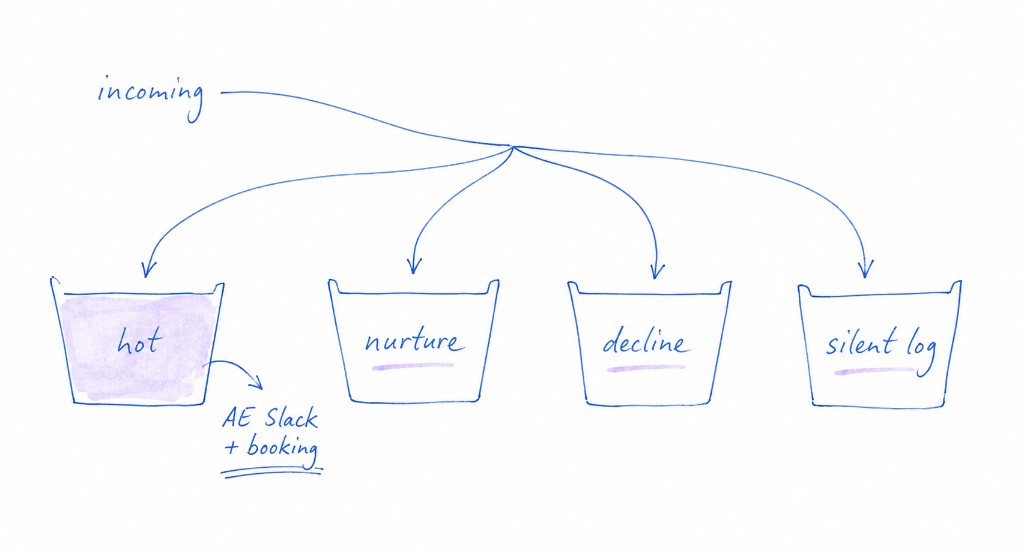
I built the qualify-and-route flow and put it in production: scoring, four buckets, Slack alerts, nurture, decline, plus a maintenance guide. When a few leads slipped, I added a light human check for non-TAP. TAP stays fully automatic.
Roughly five people’s triage work sits in that system. Top leads move in under 10 minutes. Manual BDR review is near zero. Post-launch, the under-2h SLA held ~99% of the time.
- 17h → under 10 minutes on hot inbound
- SLA under 2h hit ~99% after launch
- Sample: 240 in → 38 routed across four buckets
CRM hygiene and TAP contacts AEs can use
HubSpot had real debt: heavy duplication, missing industry data, ownership gaps. Priority TAP accounts were on the list; the people AEs needed often weren’t.
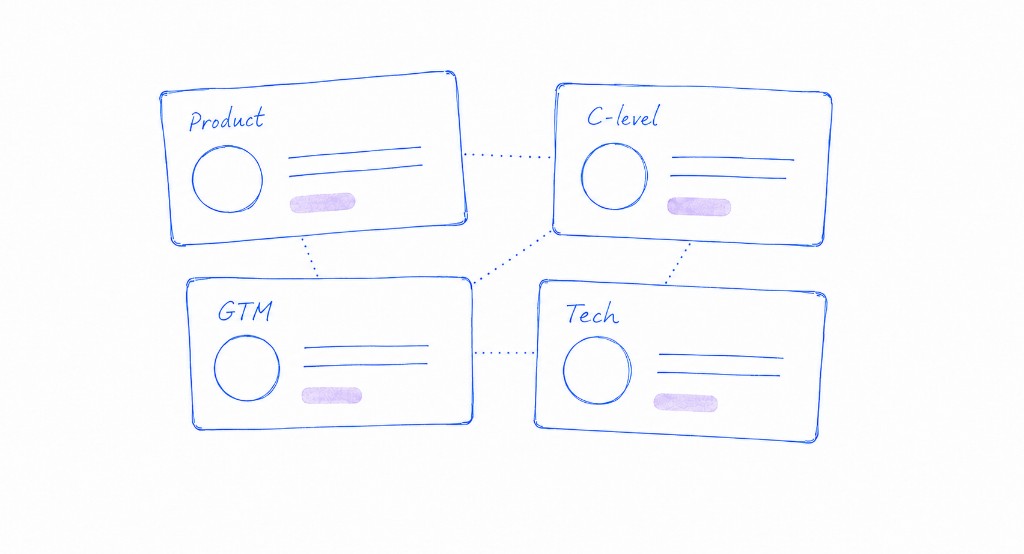
I ran a full CRM audit, deduped and enriched records with an action log, then built persona enrichment for TAP with role caps so lists stay usable. On demand I pulled champion lists for named accounts. A Dreamdata cross-check also flagged hundreds of Tier-0 companies outside pipeline tracking.
About 1,700 people landed on 335 TAP companies, with phones where we could get them cheap. AEs stopped staring at empty accounts.
- ~1,700 contacts across 335 TAP companies
- CRM audit surfaced thousands of missing industries, hard bounces, and ownership gaps
- Champion lists for 10+ named accounts on demand
An FI market universe leadership could take to the board
Marketing needed a defensible Financial Institution universe. An early list was judged not exhaustive enough, and no consolidated view of the segment existed.
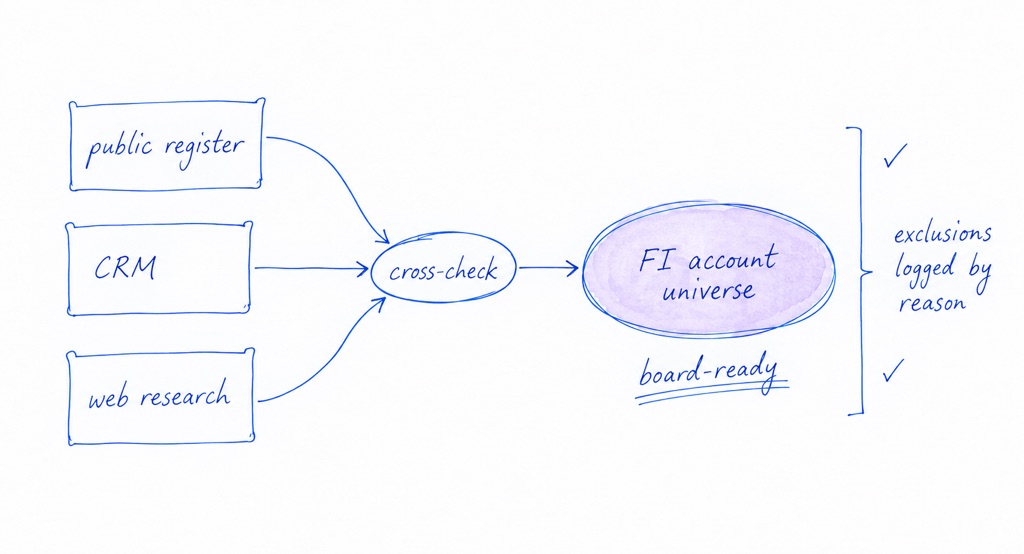
I cross-referenced a public regulatory register with HubSpot and web research, ran cleaning passes, and documented every exclusion category so the universe would hold up to scrutiny.
The result replaced the old list and became the reference behind Swan’s FI target-account work.
- Built by cross-checking a public regulatory register, the CRM and web research
- Every exclusion category documented
- Adopted as the reference for FI target-account work
A new regulated vertical, launch-ready for Sales and Compliance
Swan was opening a new regulated segment. Sales had no account data or domain knowledge, and Compliance had eligibility rules that had to stick.
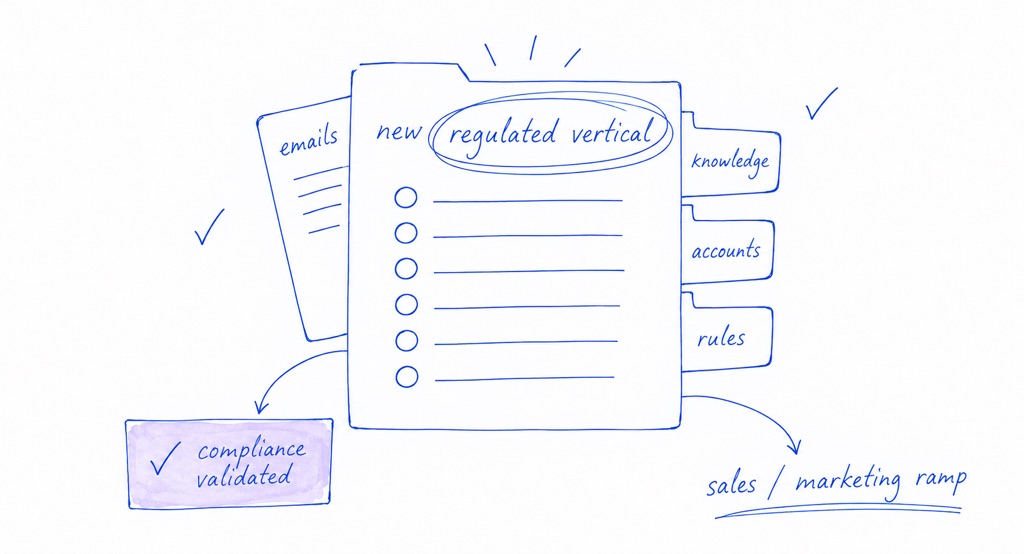
I built a knowledge base for the framework, maintained a target list enriched with size and LinkedIn data, and cross-checked it against Compliance criteria before anything hit HubSpot. Same week I enriched guest lists for VIP dinners Marketing was running.
The validated accounts landed in TAP. The knowledge base became the ramp doc for the vertical.
- Compliance-validated accounts added to TAP
- Knowledge base for Sales / Marketing ramp
- Guest-list enrichment for VIP events
A forecast brief that writes itself
Weekly forecasting was a manual pile of CRM pulls. Accuracy floated around 65–70%, and shaky deals got noticed late.
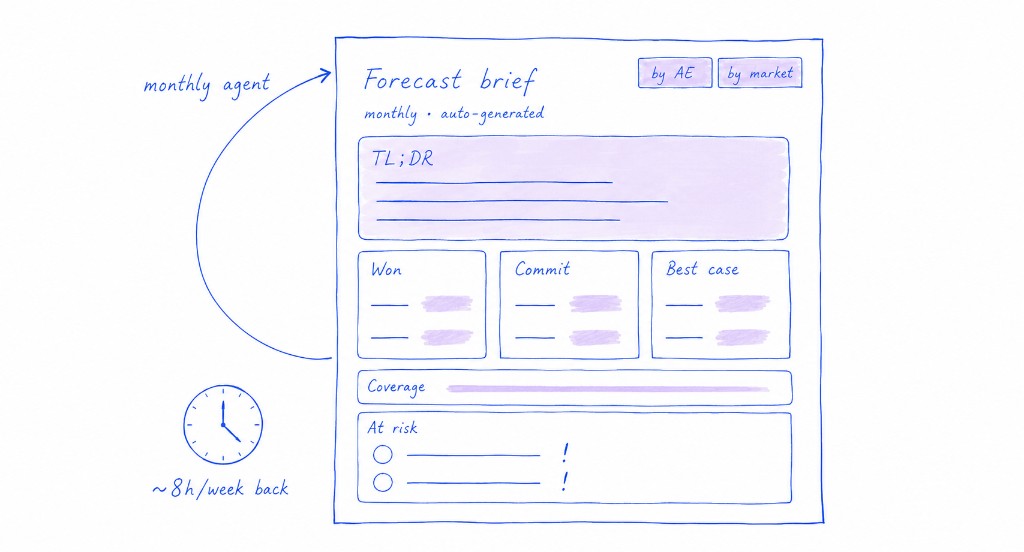
I designed a multi-agent forecast setup and shipped the first working agent. Each month it drops a Notion brief: won / commit / best case by AE and market, coverage, who’s at risk. Julio pushed on the TL;DR and conversion views. I shipped a V2 from that.
Roughly eight hours a week of senior time comes back. After I left, the report still shows up without a dedicated RevOps hire.
- Monthly Notion brief from the agent
- ~8h/week of senior time recovered
- Built to keep running without me
Cut wasted spend and speed up RevOps work
The GTM automation stack had grown organically. Legacy flows nobody tracked were still burning enrichment credits every month.
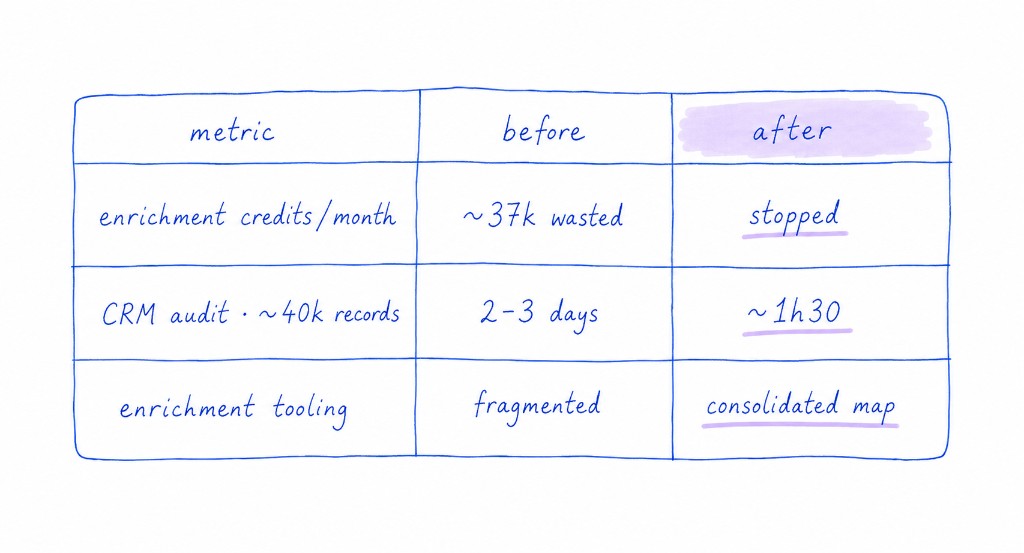
I audited the stack end to end, paused unused flows, and mapped enrichment lineage so the team had a reference. Separately I proved coding tools on real RevOps tasks, got licenses approved, and used them on the full CRM audit and other pulls.
About 37,000 wasted credits per month stopped. The CRM audit that used to take two to three days dropped to about an hour and a half.
- ~37k enrichment credits/month stopped
- CRM audit ~40k records: 2–3 days → ~1h30
- First consolidated map of enrichment tooling
Impact
Inbound doesn’t wait on a triage desk. Hot leads reach AEs in minutes, with noise filtered before it hits Slack.
Sales has TAP coverage and champion lists. Leadership has a defensible FI universe, and Compliance-safe account lists for a new regulated vertical.
The forecast brief still lands each month. About 37k enrichment credits/month stayed off. The CRM audit that used to take days still takes about an hour and a half.
Clients I've worked with
on real GTM.
The work is easiest to judge in the details: difficult ICPs, messy handoffs, and sales teams receiving leads they can actually use.
“We finally reach technical buyers with custom playbooks. We experiment fast and scale what converts, without generic templates.”

“From kickoff to delivery, the collaboration was seamless and the work was impeccable. I'd recommend them without hesitation.”

Grab 30 minutes.
Book below.
On the strategy call, I audit your stack, diagnose the ICP and signal gaps, then show what I would wire first inside your tools.